Blog
Window to the Nano World


This study investigates the microstructure and composition of an unidentified sunscreen sample using scanning electron microscopy (SEM) and energy-dispersive X-ray spectroscopy (EDS). SEM images revealed polygonal domains with heterogeneous textures, typical of dried emulsions containing dispersed particles. EDS analysis confirmed the presence of titanium (Ti) and zinc (Zn), alongside a carbon-rich organic matrix. The detection of TiO₂ and ZnO nanoparticles indicates that the formulation functions as an inorganic or hybrid mineral sunscreen. These findings demonstrate the effectiveness of SEM-EDS techniques for characterizing sunscreen formulations and distinguishing between inorganic and organic UV filters.
Sunscreens are categorized into inorganic (physical) UV filters and organic (chemical) UV filters. Inorganic sunscreens commonly use titanium dioxide (TiO₂) and zinc oxide (ZnO) nanoparticles, which scatter and absorb ultraviolet (UV) radiation. Organic sunscreens instead rely on carbon-based molecules that absorb UV photons. Identifying the type of UV filter is crucial for understanding product efficacy and formulation strategy.
In this study, a dried film of an unidentified sunscreen was analyzed using scanning electron microscopy (SEM) and energy-dispersive X-ray spectroscopy (EDS). The objective was to evaluate its microstructural and elemental composition in order to infer whether the formulation employs inorganic UV filters.
Sample Preparation: The sunscreen was applied to a silicon substrate and air-dried. To ensure electrical conductivity, a platinum coating was applied.
Instrumentation: SEM analysis was performed with a COXEM EM-40 tabletop SEM.
Parameters:
Accelerating Voltage: 20 kV
Working Distance: 11.5 mm
Magnification: ×500
Detectors: Secondary Electron (SE), Backscattered Electron (BSE), and EDS
3.1 Surface Morphology
The SEM micrographs (Fig. 1-4) revealed a polygonal surface microstructure with clearly defined boundaries and heterogeneous textures. Such features are characteristic of dried emulsions containing dispersed inorganic particles within an organic base.
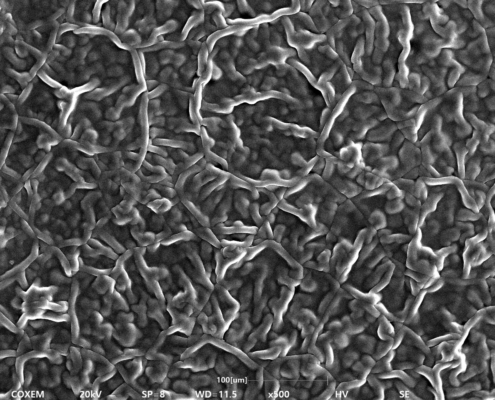
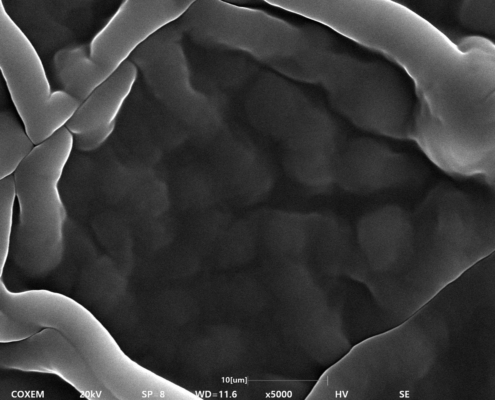
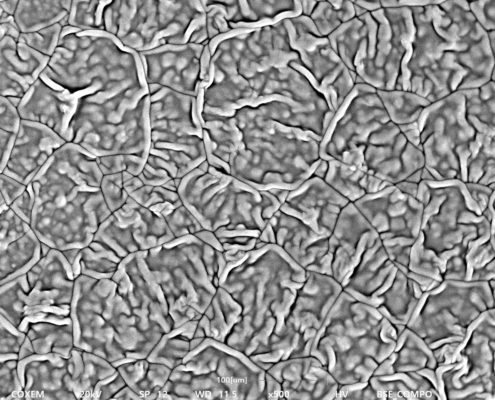

Fig. 1,2,3,4. SEM micrographs of the dried sunscreen film showing polygonal surface morphology at ×500-x5.0k magnification.
3.2 Elemental Analysis
The EDS spectrum (Fig. 3) demonstrated significant peaks for C, O, Si, Ti, Zn, and Pt.
Carbon (73.6 wt%): Dominant component, representing the organic matrix (emollients, polymers).
Platinum (10.1 wt%): From sputter coating, not inherent to the sunscreen.
Oxygen (9.3 wt%): Associated with both the organic phase and metal oxides.
Titanium (2.3 wt%) and Zinc (1.8 wt%): Evidence of TiO₂ and ZnO nanoparticles.
Silicon (2.9 wt%): Possibly from the substrate or silicone-based excipients.
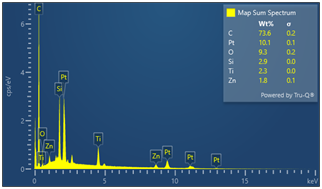
Fig. 5. EDS spectrum of the dried sunscreen film, indicating elemental composition with clear detection of Ti and Zn alongside a carbon-rich matrix.
3.3 Interpretation
The confirmed presence of titanium and zinc indicates that the formulation contains TiO₂ and ZnO nanoparticles. This strongly supports classification as an inorganic (mineral-based) sunscreen. The high proportion of carbon implies the use of an organic carrier matrix, suggesting a hybrid system combining inorganic UV filters with organic excipients.
SEM and EDS analyses of the unidentified sunscreen revealed a dried microstructure with polygonal domains and a composition rich in carbon, titanium, and zinc. These findings indicate the use of TiO₂ and ZnO nanoparticles, confirming that the formulation functions as an inorganic or hybrid mineral sunscreen. Such analyses underscore the value of SEM-EDS techniques in distinguishing sunscreen types and evaluating the dispersion of UV-protective agents.

 Permanent Tooth and An Implant