Blog
Window to the Nano World


Tteokguk, a traditional Korean rice cake soup, is one of the most representative dishes served on Lunar New Year’s Day. Although it is widely recognized as a familiar and symbolic food, its individual ingredients contain complex microstructures that are closely related to texture, processing history, and material properties. In this study, scanning electron microscopy (SEM) was employed to investigate the microstructural characteristics of the major ingredients of Tteokguk, including sliced rice cake, egg garnish, seaweed, and beef. The objective was to examine how thermal processing, drying, and extrusion influence their internal and surface structures, and to demonstrate the applicability of tabletop SEM for food microstructure analysis.
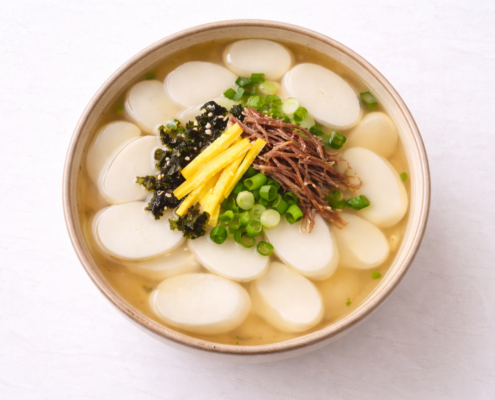
Samples of rice cake, egg garnish, dried seaweed, and cooked beef were prepared for SEM observation. Each specimen was sectioned to expose representative surface and cross-sectional regions. The samples were dried under ambient conditions to minimize residual moisture prior to SEM analysis. After drying, each specimen was mounted on an aluminum SEM stub using conductive carbon tape. To reduce surface charging and improve imaging quality, conductive coating was applied when necessary before SEM observation.
SEM analysis was performed using a COXEM EM-40 Tabletop Scanning Electron Microscope suitable for observing food-related organic structures:
These conditions enabled high-resolution visualization of both fibrous organic structures and mineral-based porous architectures.
SEM observations revealed distinct microstructural features for each Tteokguk ingredient.
The sliced rice cake exhibited a dense and compact structure formed by swollen and fused starch granules. During the heating and extrusion process, rice starch particles expanded and merged into a continuous network.
SEM images showed traces of starch deformation, micro-pores generated by moisture evaporation, and layered alignment associated with the extrusion direction. These structural characteristics are closely related to the elastic and chewy texture of rice cake.
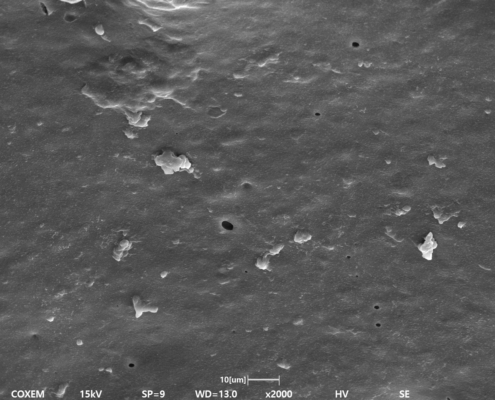
Fig. SEM images of the sliced rice cake
The egg garnish displayed a thermally denatured protein network. SEM images revealed a coagulated protein matrix with embedded microvoids and fine air pockets. Differences in structural density were also observed, depending on the degree of heat treatment. These features explain how cooking conditions influence the softness, firmness, and overall texture of the egg garnish.
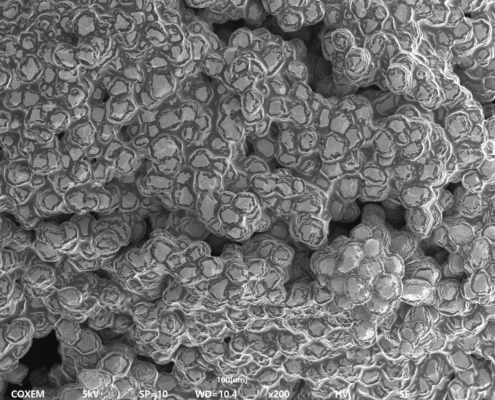
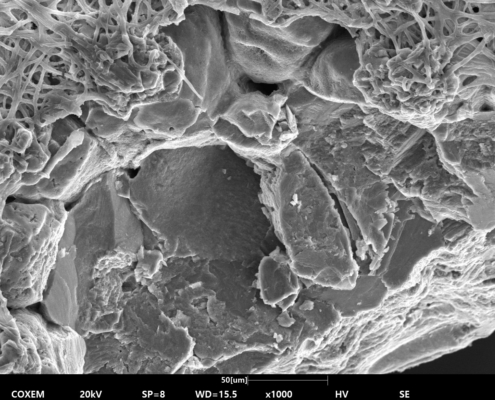
Fig. SEM images of the egg garnish
The dried seaweed exhibited a layered and porous fibrous structure. Fine wrinkles on the cell wall surface and micro-cracks generated during drying were clearly observed. The sheet-like arrangement and porous morphology are characteristic of dehydrated seaweed and contribute to its light, crisp texture.
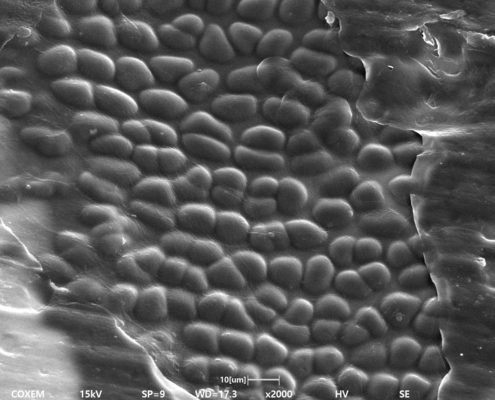
Fig. SEM images of the dried seaweed
The green onion exhibited a fibrous and porous structure made up of long, aligned tissues. SEM images clearly showed tube-like channels, distinct cell walls, and small gaps between cells. These structural features are related to moisture retention and airflow within the tissue, and help explain the fresh green onion’s crisp yet flexible texture.
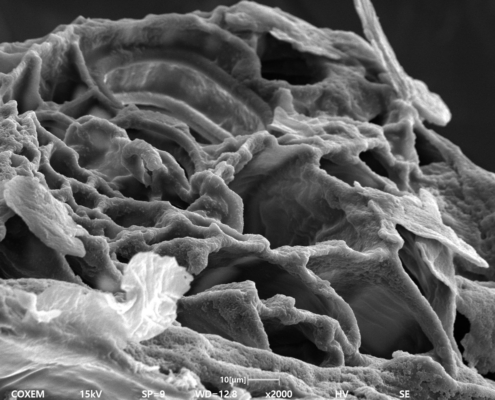
Fig. SEM images of the green onion
The beef sample showed bundles of aligned muscle fibers with distinct directional organization. SEM images also revealed contraction-related structural changes caused by cooking. The parallel arrangement of muscle fibers and thermally induced shrinkage provide useful structural insight into the relationship between cooking conditions and meat texture.
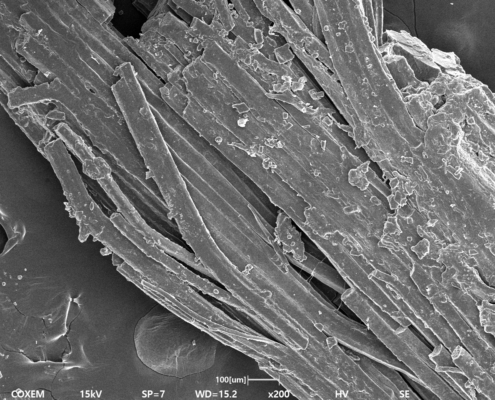
Fig. SEM images of the beef
Overall, the results demonstrate that the microstructures of familiar food ingredients directly reflect the effects of processing such as extrusion, heating, drying, and cooking. SEM analysis provides an effective way to visualize these structural changes and to better understand the origin of food texture from a materials perspective.
The COXEM Tabletop SEM (EM-40) enables rapid and reliable characterization of food materials, including surface morphology, cross-sectional structure, and process-induced microstructural changes. It is particularly useful for observing porous structures, network formation, fiber orientation, and structural density variations in processed food products. Such capabilities make tabletop SEM a valuable analytical tool not only for food research but also for quality control and product development.
This study demonstrates that COXEM EM-40 provides effective SEM characterization of common food ingredients found in Tteokguk. The observed microstructures of rice cake, egg garnish, seaweed, and beef reveal how processing history and material composition determine texture and structural properties. From everyday foods to advanced industrial materials, COXEM tabletop SEM solutions enable precise analysis of invisible structures and provide meaningful insight into the relationship between microstructure and function.

 Semiconductor and Ion Beam Polisher